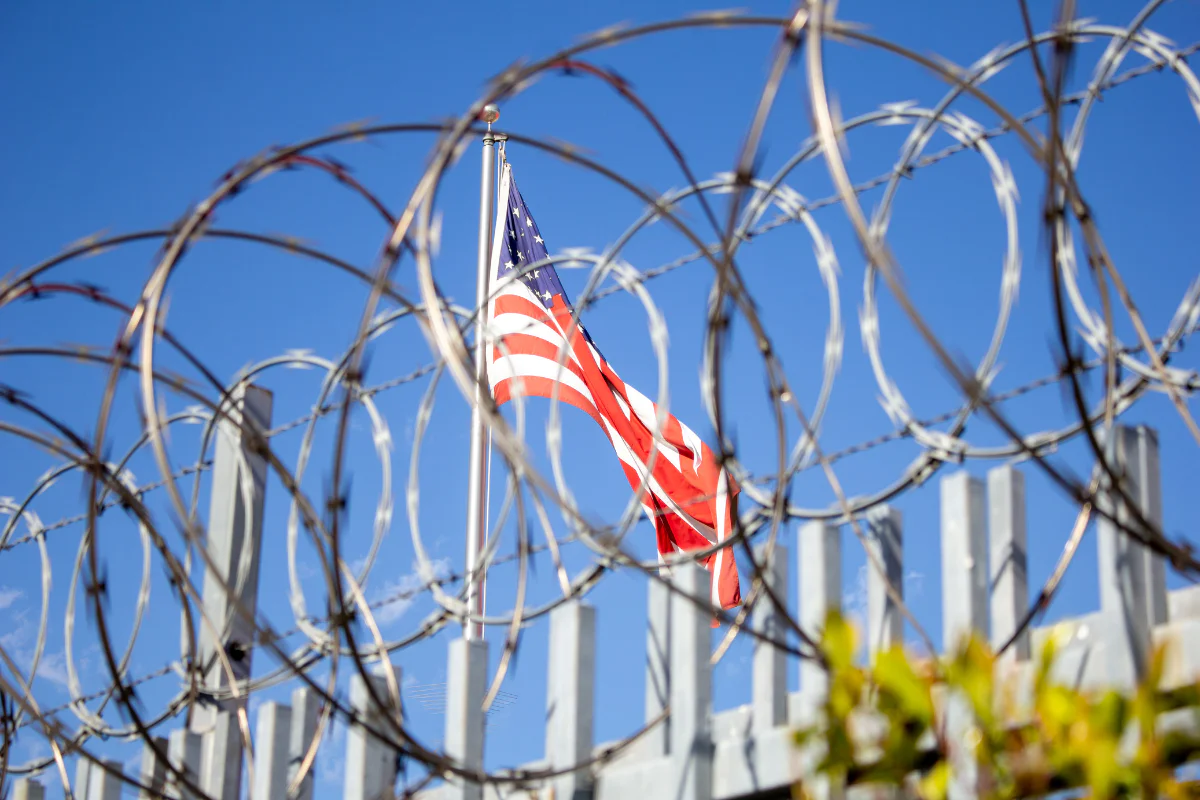
For many Indigenous Peoples whose homelands long predate the Canada-U.S. border, the right to free and unimpeded movement across this artificial line represents an important continuation of community, culture and kinship.
While this right is protected by a centuries-old treaty, The Treaty of Amity, Commerce and Navigation Between His Britannic Majesty and the United States of America (more commonly known as the Jay Treaty), recent escalations in detainment and deportation efforts by Immigration and Customs Enforcement (ICE) in the United States have left Indigenous communities uncertain about the safety of cross-border travel. Incidents occurring between ICE agents and Indigenous travellers – legal travellers carrying valid Canadian passports, Indian status cards and tribal identification – have ended in detainment, interrogation and even reports of mistreatment, calling into question whether these long-standing mobility rights will continue to be respected at the border.
Several First Nations have issued travel advisories for the United States, cautioning community members to take extra precautions to ensure any necessary documentation is in place and accessible at all times when crossing the border, despite clear entitlements under the Jay Treaty.
Jay Treaty Article III: Affirming Indigenous Mobility
Article III of the Jay Treaty explicitly acknowledges that Indigenous nations existed long before the establishment of the Canada-U.S. border and that their movement across it should not be restricted, stating that:
“It is agreed that it shall at all Times be free to His Majesty’s Subjects, and to the Citizens of the United States, and also to the Indians dwelling on either side of the said Boundary Line freely to pass and repass by Land, or Inland Navigation, into the respective Territories and Countries of the Two Parties on the Continent of America…and to navigate all the Lakes, Rivers and waters thereof, and freely to carry on trade and commerce with each other.”
With this, Article III affirms that Indigenous Peoples may:
- Freely cross the Canada–U.S. border
- Carry on trade and commerce
- Move without paying duties or facing restrictions placed on non‑Indigenous foreigners
U.S. interpretation of Jay Treaty rights
Irrespective of recent developments, the United States government continues to recognize the Jay Treaty and its corresponding legislation, affirming that Jay Treaty entrants “are entitled to freely enter the United States for the purpose of employment, study, retirement, investing and/or immigration.” Under U.S. federal law (8 U.S.C. § 1359), “American Indians born in Canada” are entitled to:
- Enter the U.S. freely
- Live in the U.S. without a visa
- Work in the U.S. without the need for a work permit
- Obtain documentation confirming their special status
Entrant requirements
For an individual to qualify as a Jay Treaty entrant, the United States government requires proof of possession of at least 50% Indigenous ancestry. The Jay Treaty Border Alliance, formed by tribal governments and First Nations communities in 2017, strongly recommends carrying the following pieces of documentation at all times when crossing the border to mitigate any potential risks of detainment by U.S. Customs and Border Protection and ICE:
- Tribal letter confirming at least 50% “American Indian blood quantum”
- Secure Certificate of Indian Status (SCIS) card with red stripe
- Long-form birth certificate
- Form I-181 or I-551 “Green Card,” if possessed
- Government-issued photo ID
The right to apply for a U.S. “Green Card”
Individuals born in Canada with at least 50% Indigenous Ancestry or “American Indian Blood” who are travelling to the U.S. with the intent to live and work permanently (including those residing in the U.S. while attending school) have the right to apply for Lawful Permanent Residence (Green Card) status.
While not required, Indigenous travellers can apply for this status based on Jay Treaty eligibility. This is optional – Jay Treaty rights already allow for indefinite residence and work – but could make the process of border crossing simpler and safer. We encourage those who qualify and travel frequently to apply for the U.S. Green Card as further evidence of their lawful status in the U.S.
What is required to apply for Lawful Permanent Residence (LPR)?
Indigenous Canadians completing the Green Card for an American Indians Born in Canada application will require specific documentation to apply successfully. This documentation includes:
- Ancestry letter from Indigenous Services Canada showing lineage for at least three generations
- Original long-form birth certificate, showing their mother’s and father’s names
- Original Status Card, showing current status
- Band letter stating lineage and current residency/membership
- Copy of criminal record, if applicable
- Letter from employer in the U.S. that includes (if applicable):
- Confirmation and terms of employment
- Employer address
- Legal letter explaining and setting forth the legal basis in U.S. law for their application
- Current passport
- Two current passport photos taken within the last six months
What is the process for applying?
If you wish to apply for Green Card in the United States, you can make the application at designated Ports of Entry along the U.S. and Canadian Border. The process is as follows:
- Schedule an appointment with USCIS:
- At the U.S. border, inform CBP that you are seeking admission as a permanent resident
- Complete necessary USCIS Forms
- Receive a temporary stamp in your passport reflecting permanent resident status
- Visit a USCIS office to provide biometrics information
- USCIS will mail the physical Green Card after processing
A processing fee of US$235 will be required for issuance of the physical Green Card.
Key takeaways
More than 230 years after it was signed, the Jay Treaty remains an important legal tool and a powerful symbol. Its recognition of border mobility stands as both a legal instrument and a testament to the resilience of Indigenous nations whose lands and cultures transcend colonial boundaries. Governments must reckon with Indigenous sovereignty and nationhood, as the entitlements of Indigenous communities in both Canada and the United States aren’t so easily dismissed.
Indigenous travellers looking to enter the U.S. from Canada are strongly encouraged to review their Treaty rights and ensure that they enter the country with all relevant documents confirming their lawful status. For further guidance on this matter, readers are encouraged to reach out to the authors of this Insight or any other members of the MLT Aikins immigration or Indigenous practice groups.
Note: This article is of a general nature only and is not exhaustive of all possible legal rights or remedies. In addition, laws may change over time and should be interpreted only in the context of particular circumstances such that these materials are not intended to be relied upon or taken as legal advice or opinion. Readers should consult a legal professional for specific advice in any particular situation.
Share